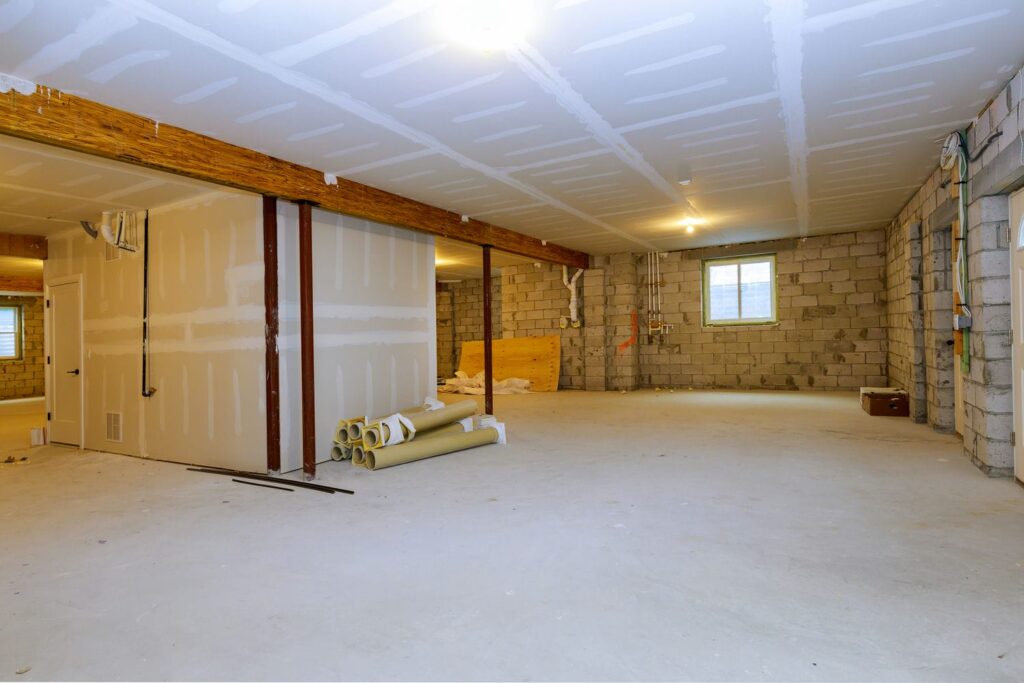
Basement Backwater Valve Flood Prevention: What It Really Costs in the GTA
A professionally installed backwater valve runs $1,500 to $5,000, according to the Intact Centre on Climate Adaptation at the University of Waterloo. That is the number to plan around. The $300 you have probably seen is real, but it is a Toronto figure: the City pays 80 percent of the invoice to a maximum of $1,600 per device, so on a $1,500 installation the City covers $1,200 and the homeowner is left with $300. Basement backwater valve flood prevention is the same piece of work in every driveway on your street. What changes is the municipality your house sits in. Richmond Hill’s subsidy can cover a smaller job outright, and Aurora, Barrie and Bradford West Gwillimbury run no program at all. Your address moves this number far more than your plumber does. One thing to settle before you price anything: the cheap time to do this work is while the slab is open, which is why a good basement finishing contractor puts it in the schedule instead of on a list of jobs for later.
Basement Backwater Valve Flood Prevention: What the Device Actually Does
Most homeowners buy this device without ever seeing one. What it does and what it cannot do decide whether it is the right purchase for your house at all.
The One Way Gate on Your Sewer Line
A backwater valve is a one way gate installed in the sanitary drain line that leaves your house. It normally sits open and everything flows out to the street as usual. When the municipal sewer surcharges and pressure reverses, a flap swings shut and sewage stops at the valve instead of coming up through your basement floor drain, laundry tub, shower or basement toilet.
Here is why the problem exists at all. Municipal sanitary sewers are sized for sewage, not for storms. During heavy rain, water that belongs in the storm system finds its way into the sanitary system through wrongly connected downspouts, foundation drains tied into the sanitary lateral, cracked pipe and leaky manhole covers. The sewer fills, the pipe pressurizes, and the lowest opening in the connected system becomes the relief point. In a house with a basement, that opening is your floor drain.
Do You Already Have One?
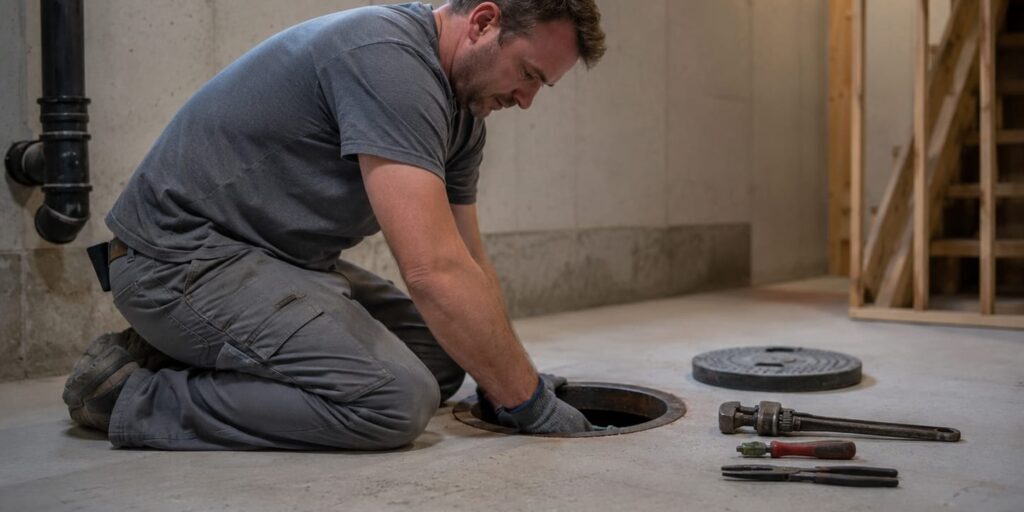
Plenty of homes in this service area already have a valve and the owner has no idea. Look for a round or rectangular access cover set flush into the basement slab, usually near the floor drain or somewhere along the line running toward the street. It normally has a threaded or bolted lid, and it is often the only round metal or plastic plate in an otherwise plain floor.
In a finished basement it can be harder to find, because it may sit under flooring, inside a closet, or behind a built-in. If that is your situation, you have found a second problem rather than an answer, so keep it in mind for the access planning below. If nothing is visible anywhere, the honest next step is a plumbing assessment or a camera inspection of the lateral rather than guesswork.
Now the part people skip. Having a valve is not the same as being protected. A valve nobody has opened in 10 years is a device with an unknown flap, an unknown seal, and a decade of grease sitting on both. Find yours, then read the maintenance section below and put it on a schedule.
Not Every Valve Is Legal
There is a specification behind this, and it rules out most of what you can buy off a shelf. The City of Toronto applies the Ontario Building Code this way: the valve installed in a building drain must be a full port, normally open type conforming to the applicable CSA standard, and a valve designed to sit normally closed is prohibited. Normally open matters because it lets air circulate and lets solids pass in ordinary use.
Newmarket says the same thing more bluntly. Its subsidy program requires a valve approved for residential use, with no exceptions written into the rule.
So this is not a hardware store part and an afternoon. It is a specified device, installed by a licensed plumber or drain contractor, inspected afterward, and documented well enough that a municipality will pay against the invoice.
Three Ways a Basement Gets Wet, and the One This Fixes

Most homeowners cannot tell these three apart, and a fair amount of marketing is happy to leave it that way. The good news is that the diagnosis is usually simple. Where the water came out tells you which problem you have, and each one has a different fix.
Sewer Backup, Groundwater, and Surface Water
Sewer backup is the one this device is for. The municipal sanitary sewer is over capacity, reverses into your home through its own drain pipes, and comes up out of the lowest fixture in the house. It is foul, it is fast, and a valve is very good at stopping it.
Groundwater and hydrostatic seepage is a different animal. Water in the soil pushes through foundation cracks, cold joints and the slab itself, usually slowly and usually in the same spot every wet spring. Drainage and waterproofing address that. A backwater valve does nothing about it whatsoever.
Surface water is the third. Rain runs down a grade toward the house, fills a window well, or comes down an exterior basement stairwell and in through the door. Grading and downspouts are the answer there, and again the valve is irrelevant.
The diagnostic is short enough to remember. Clean water at the base of a wall is not a sewer backup. Sewage at the floor drain is. Your home insurance is carved up along these same three lines, with sewer backup and overland flood sold as separate optional coverages, which is covered further down.
Backwater Valve or Sump Pump
These get confused constantly, and they are not substitutes. Different water, different device, and a great many homes need both. A sump pump collects groundwater in a pit and pushes it out of the house. A valve blocks sewage trying to come back in through the drain line.
The Town of Aurora is direct about the limits of a sump pump: they are designed to move water at a slow rate, they may not keep up if a basement is actively flooding, they need maintenance, and they stop entirely during a power outage. That last one matters, because the storms that flood basements are the storms that knock out power.
A valve has the opposite profile: no motor, no power draw, nothing to fail in an outage, and no help at all with groundwater.
Here’s the Catch: Nothing Drains While the Valve Is Closed
Once the valve shuts, nothing in the house can drain to the sewer. Aurora states it plainly for residents: you cannot bathe, shower, run a washing machine or dishwasher, or flush the toilet until the conditions causing the backflow have cleared.
That produces a real decision, and it is one to make with your plumber rather than discover during a storm. A mainline valve protects the whole house, and while it is closed nothing anywhere in the house drains. A branch valve protects only the basement fixtures, leaving the upper floors free to drain normally while the basement is sealed off.
Most homeowners default to the mainline valve, and that is the right call only if the household knows what closing means.
What a Backwater Valve Costs to Install
The valve is the cheap part of this job. The work is the access: getting to a pipe that is buried under a concrete floor, cutting it, and putting everything back so it looks like nothing happened. That is what you are paying for, and it is why the price range is as wide as it is.
The Installed Range, and Why to Plan Against the Top of It
The Intact Centre on Climate Adaptation at the University of Waterloo puts a professionally installed backwater valve at $1,500 to $5,000. That range has been in place for several years. Toronto raised its own valve and sump pump subsidies by 28 percent in 2026 specifically to reflect inflation and market costs, which points the same direction: real prices in this market have moved up, not down.
So plan against the upper end of that range and treat the lower end as the best case.
What Drives the Price Up
A retrofit is a sequence, and every step in it costs money. Locate the sanitary line inside the basement. Break the concrete slab. Excavate down to the pipe. Cut the pipe, seat the valve in line and level, and set a flush access box with a removable lid. Then backfill, re-pour the slab, and arrange the permit and inspection.
In practical terms, that is a plumber for most of a day, plus a concrete cutting and disposal operation, plus a hole in your floor that has to cure and be made good. It is noisy, dusty work confined to one room rather than a whole house shutdown, and you should expect the restoration to stretch the calendar more than the plumbing does. Curing concrete does not care about your schedule.
Three things move the number most. Depth and run length drive how much spoil comes out and how much concrete goes back. Working under finished space turns a plumbing job into plumbing plus restoration. And the condition of what you find when the slab comes up occasionally changes the scope entirely. Notice that municipalities themselves treat labour, materials, camera inspection, permits and taxes as eligible costs, which tells you plainly that they consider this a project rather than a part.
The Permit Is the Cheapest Line on the Invoice
Toronto’s backwater valve permit fee is $38.67, effective 1 January 2026, and the City resets its fees annually. When Newmarket introduced its program, the Town’s permit fee for the installation was $185. Against a job that starts at $1,500, both are rounding errors.
Which makes skipping the permit the worst possible saving. It is not simply that unpermitted plumbing work on a building drain creates a problem the day you sell. Every subsidy program in the GTA requires a permit and an inspection before it pays anything. Save $38.67 in Toronto and you forfeit up to $1,600. That is not a trade, it is a mistake.
What You Actually Pay Depends on Your Municipality

Here is the part almost nobody tells you before you sign a quote. Same device, same plumber, same week of work, and a net cost that runs from nothing to the full $1,500. Across the eight places in this service area there are seven distinct programs, because Concord falls under Vaughan. The figures below are what the rules produce.
The net figures are worked from each municipality’s published subsidy rule applied to a $1,500 installation, the bottom of the installed range. They illustrate how the rules work. They are not quoted prices, and a higher installed cost moves every number in the right hand column up.
What a Backwater Valve Costs After Your Municipality’s Subsidy
| Municipality | Subsidy Rule | Net Cost on a $1,500 Install | Deadline to Apply |
| Richmond Hill | Up to $1,500, flat cap | $0 | 6 months from completion |
| Toronto | 80% to a max of $1,600 per device | $300 | 2 years from completion |
| Vaughan (and Concord) | 50% to a max of $750 | $750 | 1 year from completion; confirm current terms with the City |
| Newmarket | Up to $500 | $1,000 | Confirm current terms with the Town |
| Aurora | No program published | $1,500 | Not applicable |
| Barrie | No program published | $1,500 | Not applicable |
| Bradford West Gwillimbury | No program published | $1,500 | Not applicable |
On the same $1,500 installation, a Richmond Hill homeowner can pay nothing and a homeowner in Aurora, Barrie or Bradford West Gwillimbury pays all $1,500. Same device, same work, same week. The difference is which side of a municipal boundary the house sits on.
Toronto Runs the Largest Program, and Most People Still Have Not Claimed It
Toronto’s Basement Flooding Protection Subsidy Program is the biggest in the service area by some distance. It covers 80 percent of the invoiced cost of a backwater valve to a maximum of $1,600 per device, for up to two devices, inside a total property cap of $6,650 that also takes in sump pumps, home plumbing assessments and foundation drain work. You have 2 years from completion of the work to apply.
Now the number that should get your attention. Since the program began in 2007 it has issued roughly $86 million across about 59,000 applications, and participation among eligible properties still sits near 14 percent. Severe rain in 2024 flooded more than 1,000 Toronto homes. Most eligible owners have simply never claimed money the City is holding for exactly this purpose.
One caution before you count on it: the program is first come, first served and depends on annual Council funding, so it can run out in a given year. Apply early rather than late.
Richmond Hill: Up to $1,500, and a 6 Month Window
Richmond Hill puts up to $1,500 toward the installation, and it counts labour, materials, permit fees and taxes as eligible costs. Those four items are effectively the whole contractor invoice on a licensed install. At the lower end of the price range, that can cover the entire bill.
There are two traps in this program and both cost real money. The application window is 6 months from completion, not Toronto’s 2 years, and 6 months disappears quickly once a renovation is finished. More importantly, the building permit must be in hand before installation starts. Get that order wrong and the subsidy is gone, no matter how compliant the finished work is.
Treat the money accordingly. It is capped, granted first come, first served, and the City approves the final amount case by case. That makes it money you apply for rather than money you can count on when you sign the quote.
Which City Wins Depends on the Size of the Job
Toronto pays a percentage. Richmond Hill pays a flat amount. That single difference means the better program depends entirely on how big your invoice is, which is why comparing the two in the abstract gets people nowhere.
On jobs below roughly $1,900, Richmond Hill’s flat $1,500 goes further, because it can absorb the whole bill while Toronto’s 80 percent always leaves the homeowner with the other 20 percent. Around a $1,900 invoice the two land in about the same place. Above that, Toronto’s larger cap does better, and once the invoice passes about $2,000 Toronto’s $1,600 cap binds and Toronto stays roughly $100 ahead no matter how large the job gets.
None of this is a reason to move house. It is a reason to read your own municipality’s rule before you assume your neighbour’s experience applies to you, especially if your neighbour lives on the other side of a boundary.
Vaughan and Concord: 50 Percent to $750
Vaughan covers 50 percent of the invoiced cost to a maximum of $750, including eligible labour, materials, permit fees and taxes. The work must be done by a certified plumber who can supply an Ontario College of Trades membership number on the invoice, and the program applies to existing residential properties only. You have 1 year from completion to apply.
Concord addresses fall under the City of Vaughan, so Vaughan’s subsidy is the one that applies to them. There is no separate Concord program to look for.
Confirm the current terms with the City before you book the work.
Newmarket, Our Home Market
Newmarket introduced its sanitary backwater valve subsidy at up to $500 per property for existing single family homes, covering eligible labour, materials, permit and taxes. A plumbing permit and an approved inspection are both required, the installation has to be done by a qualified licensed plumber or drain contractor, and the subsidy is granted one time only per property.
The scale of the program is worth knowing. It launched on a $10,000 annual budget, which funds roughly 20 subsidies a year across the whole Town. First come, first served is a hard constraint here, not boilerplate. The Town also targets outreach at previously flooded streets first, holding funding for those addresses until the first week of August before opening it to all residents. The local risk behind that approach is real: 14 claims came against the Town from the June 2017 storm alone.
Confirm the current amount with the Town before you book the work. Funding is limited and granted first come, first served.
One quick disambiguation, because the names collide. Newmarket’s Backflow Prevention Program is a different thing entirely: it protects the drinking water supply in industrial, commercial, institutional and multi-residential buildings, and it has nothing to do with residential sewer backup.
Aurora, Barrie, and Bradford: Budget the Full Amount
Not every municipality helps with the cost, and it is better to know that before you build a budget around a rebate. Aurora publishes solid guidance on basement flooding, sump pumps and homeowner responsibility, and it runs no valve subsidy.
Barrie funds the cause instead of the device. Its Disconnect to Protect program pays up to $70 to disconnect downspouts, 75 percent to a maximum of $2,000 to disconnect a foundation drain from the sanitary lateral and build a new sump and pump, and 75 percent to a maximum of $300 to cap an existing sanitary drain and install a sump pump with surface discharge. That is a genuinely interesting choice and worth naming for what it is: Barrie is paying to keep storm water out of the sanitary system in the first place, which is the upstream version of the same problem.
Bradford West Gwillimbury does not run a subsidy either, and the Town’s stated position explains why. All the internal plumbing of a home, backwater valve included, is privately owned by the homeowner, who is responsible for maintaining it. If you are in any of these three, budget the full installed cost and check with your municipality before you book the work in case a program has opened.
That ownership point is worth holding onto, because it explains why the bill is yours at all. The sewer pipe running from your house to the property line is owned and maintained by you. The local city or town is responsible for the stretch between the property line and the main. In York Region, the Region looks after the main itself.
Permits and Inspections

This is the cheapest, fastest and least negotiable part of the job. It is also the part that unlocks the money, so it is the last place to look for a shortcut.
What Toronto Requires
In Toronto, a house with one or two dwelling units needs a building permit to install a backwater valve. Multi-unit and non-residential buildings need a stand-alone drain permit instead. For one and two unit houses, no plans are required with the application, which keeps the process genuinely simple.
If you are wondering whether the rest of your project needs one too, the answer is usually yes, and it is worth knowing which basement work needs a permit before you set a schedule. Permits are one of the most common reasons a basement timeline slips.
The Inspection Checks One Thing You Can Design Around
Newmarket requires a plumbing permit and an approved inspection, and the inspection confirms two things: that the approved unit was installed in the direction of flow, and that it is accessible for maintenance. The first is the plumber’s problem. The second is yours, and it is a design decision.
Accessibility gets checked at inspection and then gets forgotten for a decade, which is exactly backwards. Knowing what happens at a renovation inspection ahead of time lets you put the access cover somewhere sensible rather than defend a bad location to an inspector standing in your basement.
Do It While the Slab Is Open
This is a sequencing decision, not an upsell. The same valve, in the same house, costs meaningfully different amounts depending on when in the project it goes in, and the difference is not the plumbing.
Before the Floor Goes Down Versus After
During a renovation, the concrete work, the disposal and the restoration are already in the schedule and the trade is already on site. Cutting the slab is a scheduled task among other scheduled tasks. Nobody is protecting finished surfaces, because there are none yet.
Afterwards, the same device means cutting a hole in a finished floor, running dust containment through finished space, working around furniture, and then matching flooring that may no longer be manufactured. The plumbing is identical. The job is not.
Plan the Access Cover Into the Design
The valve has to stay reachable forever, not just until the drywall goes up. An inspector checks for access, and you will open it at least once a year for the rest of the time you own the house. A cover that ends up tiled over or framed into a bulkhead is a valve that will never be maintained.
So treat it the way you treat every other service that has to stay reachable: settle its position on the layout before framing, and keep it clear of built-ins, permanent shelving and the middle of a finished floor if you can. The same discipline that goes into planning access around basement mechanicals applies here, at a much smaller scale and for the same reason.
What a Backup Actually Costs a Finished Basement
One sewer backup undoes most of what you spent finishing the basement. Here is what it actually destroys, and the one thing to check before you rely on luck.
Porous Things Do Not Get Cleaned, They Get Thrown Out
York Region Public Health advises assuming that everything touched by sewage water is contaminated, because it may carry pathogenic micro-organisms that make people ill. Porous items that cannot be cleaned and rapidly dried are to be discarded, and the list is specific: mattresses, carpeting, carpet padding, rugs, upholstered furniture, books and wall coverings. Drywall left standing in water should be removed and discarded as well.
Translate that into a finished basement and the picture is clear. A sewer backup is not mopping. It is the carpet, the underlay, the sectional, the bookshelf contents and the bottom courses of drywall, all of it out to the curb.
Then comes the second problem. Whatever stays wet after the obvious material is gone turns into a moisture problem with its own timeline, and what happens when a basement stays wet is a slower and more expensive story than the flood itself.
Check Whether Your Policy Even Covers This
Sewer backup coverage is an optional add-on that you have to buy on purpose. Standard home policies do not include it, according to the Insurance Bureau of Canada, and a lot of homeowners find this out on the worst possible day. Overland flood coverage is a separate endorsement again, written for different causes: overflowing rivers, ponds and surface water from heavy rain or melting snow.
York Region tells residents outright to review the policy or call their agent to confirm whether sewer backup damage is covered. That is a 10 minute phone call and it is worth making before you spend anything on a valve.
On discounts, be careful with what you read elsewhere. Whether a backwater valve changes your premium is set by each insurer, not by any provincial rule, so ask yours directly rather than assuming a discount is waiting for you.
Keeping the Valve Working

These devices almost never fail mechanically. They fail because nobody opened them, and they fail because the household kept using water at the one moment it should have stopped. Both failures are free to prevent.
Clean It Out at Least Once a Year
Clean it at least once a year, and twice is better. The Intact Centre recommends maintaining what you already have twice per year as a matter of routine, and for a device sitting in a sanitary line that is sound advice rather than caution for its own sake.
The work itself is undemanding: lift the lid, clear what has collected on and around the flap, check that the flap moves freely and seats cleanly, and close it up. Done yourself it costs nothing. Done for you it runs $100 to $300, and a seasonal plumber check runs about the same.
One optional item earns its keep in a finished basement. A valve alarm costs $75 to $150 and tells you the flap has closed, which is precisely the information the household needs before someone starts a shower.
What Actually Stops a Valve From Sealing
Grease, wipes, roots and grit. That is the list. The Town of Aurora names grease build-up and debris as the maintenance issue, and everything about this device’s reliability follows from that. A flap cannot seal against a ridge of hardened grease, and no brand of valve is immune to what goes down the drain above it.
There is a second failure mode worth naming, and it is not mechanical at all. A valve installed on a house whose real problem was groundwater will work perfectly while the basement floods anyway. The device is not defective. The diagnosis was.
The Storm Day Rule
When the sewer surcharges and the valve closes, stop running water. That is the whole rule, and households break it constantly.
The reasoning is simple once you have pictured it. The valve has sealed your drain line off from the street, so every flush, every shower and every wash cycle goes into a sealed pipe with nowhere to drain. The house then fills from its own plumbing, which is a worse outcome than the backup you were protected from.
Wait until the storm passes and the system drains.
Get the Valve Into the Plan, Not the Punch List
A backwater valve belongs to a short list of decisions that are cheap while a basement is open and expensive once it is finished, alongside rough-ins, subfloor and mechanical access. We would rather put it in the schedule than write it into a change order. Yorkland Homes has been a family owned business since 2010, we work on a transparent pricing contract model so a line like this is visible before you sign rather than after, and our build schedules are planned in enough detail that the slab work, the permit and the inspection land in the right order instead of colliding with your flooring date.
If you are planning a basement, this is the right moment to have the conversation. Our basement renovation services cover the sequencing as much as the finishes, and you are welcome to book a consultation and walk us through the space before anything is committed.
Frequently Asked Questions
No. They handle different water with different mechanisms. A backwater valve is a one way gate that blocks sewage coming back into your house through the drain line, with no motor and no power supply. A sump pump collects groundwater in a pit and pumps it out, which means it needs electricity and maintenance to work. Many homes need both, because sewer backup and groundwater are separate problems.
Not to install. The installed range is $1,500 to $5,000. In Toronto, after the City’s 80 percent subsidy up to $1,600 per device, a homeowner’s share on a $1,500 job comes to about $300. What you pay depends entirely on your municipality: Richmond Hill’s subsidy can cover a smaller installation outright, Vaughan covers half to a maximum of $750, and in the towns with no program you pay the whole thing yourself.
Yes, and it is inexpensive. Toronto requires a building permit for houses with one or two dwelling units, at a fee of $38.67 effective 1 January 2026. Richmond Hill requires the permit to be in hand before work starts, which is a sequence worth getting right. Newmarket requires a plumbing permit and an approved inspection. Skipping the permit forfeits the subsidy, which is always worth far more than the fee.
Not retroactively. Existing homes are not ordered to add one. New work is a different matter: where a valve is installed it has to meet the Ontario Building Code as municipalities apply it, and the City of Toronto specifies a full port, normally open device. Every subsidy program in the table above also requires a compliant valve, a licensed installer, a permit and an inspection before it pays out. So it is optional for your house and mandatory for your money.
It stops one cause, which is sewage backing up from the municipal sewer during a surcharge. It does nothing about groundwater pushing through the slab or foundation, and nothing about surface water running in from outside. Where the water appeared tells you which problem you have: sewage at the floor drain is a backup, clean water at the base of a wall is not.
At least once a year, and twice is better. Grease, wipes, roots and grit are what stop the flap sealing, so the job is simply clearing what has collected and checking that the flap moves and seats freely. Doing it yourself costs nothing, and having it done runs $100 to $300. A valve that nobody opens is not protection, whatever the brand on the lid.
No. Nothing drains while the valve is shut, so every flush, shower and wash cycle goes into a sealed line with nowhere to go and comes back into the house. Aurora tells residents the same thing: no bathing, showers, laundry, dishwasher or toilet until the backflow conditions clear. Wait until the storm passes and the system drains.
Only if you bought the optional sewer backup endorsement on purpose. Standard home policies do not include it, and overland flood coverage is a separate product written for different causes such as overflowing rivers and surface water. Whether installing a valve affects your premium is up to your individual insurer rather than any provincial rule, so ask yours directly. Reviewing the policy takes minutes and is worth doing before you spend on the device.
Check out more posts below...

In-Law Suite Vs. Legal Rental In Newmarket: Which Fits?
Why Older Newmarket Basements Often Need Underpinning
What Newmarket Requires To Register A Basement Suite

Basement HVAC Basics: Return Air, Zoning, And Year-Round Comfort